

What is dyspepsia?
Dyspepsia, also known as indigestion, can have multiple symptoms. Feelings of indigestion happen during or after eating.
If you have indigestion you might feel:
- Full during a meal.
- Painful fullness after a meal.
- Heat, burning or pain between your belly button and lower breastbone (upper belly).
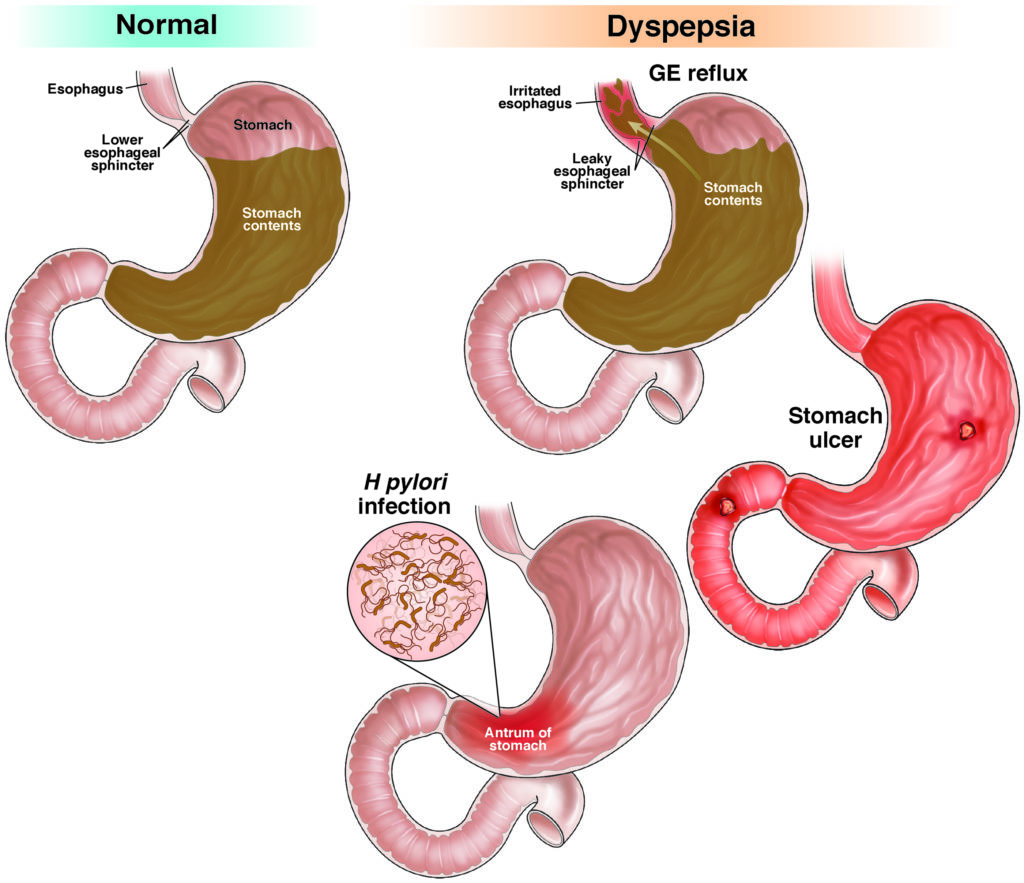
Symptoms of dyspepsia
You may have one or more of these feelings if you are experiencing indigestion:
- The feeling of being full or getting full quickly during a meal (and being unable to
complete the meal). - Painful fullness after a meal (as if food is staying in the stomach too long and not
moving). - Heat, burning or pain between your belly button and lower breastbone (in the upper
belly); this pain can range from mild to very bad.
Some less frequent feelings that could be linked to indigestion are:
- Bloating (bad swelling in the stomach).
- Excessive gas in the abdomen.
- Throwing up.
- Burping or belching.
- Nausea.
- Flatulence or feeling “windy.”
Talk to your doctor if:
- Your indigestion lasts more than two weeks.
- Your symptoms change (they get a lot worse or become more common or ongoing).
- You see blood in your stool (or you start throwing up blood).
- You experience sudden weight loss for no reason.
- You start having really bad belly pain.
- You have trouble swallowing.
- You start experiencing jaundice (when your skin and/or the whites of your eyes turn yellow).
Causes of dyspepsia or indigestion
There are a number of things that could cause the symptoms of indigestion. For some, certain actions can cause feelings of indigestion, such as:
- Eating too fast.
- Eating too much in one sitting.
- Eating high-fat, greasy or spicy foods.
- Smoking.
- Drinking alcohol.
- Consuming too much caffeine.
- Experiencing stress.
- Taking some drugs.
- Taking too many painkillers (for example, for headaches or muscle/joint pain).
Other causes of indigestion (non-ulcer dyspepsia) could be
- Gastroesophageal reflux disease (GERD).
- Peptic ulcer disease.
- Problems of the pancreas or bile ducts.
- Gallstones.
- Gastritis.
- Cancer.
Functional dyspepsia
Tests for dyspepsia
Getting tested for indigestion, or to find the cause of it, is a key step to feeling better.
- An X-ray of the stomach and/or small intestine.
- An ultrasound of the belly.
- A blood, breath or stool test (to look for bacteria or allergies).
- An endoscopy (with biopsy).
What to expect during endoscopy
An endoscopy is done to get a small piece of tissue (biopsy) from your esophagus (the tube that
links your mouth and stomach) to see if there is damage.
The tube is passed through the mouth into the small intestine as your gastroenterologist does a
careful exam to check for damage. Learn more about endoscopy and how to prepare.
Treatment for dyspepsia
Your indigestion symptoms are unique to you.
Your gastroenterologist can help you find out the cause of your indigestion, so you can work together to develop the best plan to handle your symptoms. Your choices will depend on the
cause of your indigestion.
Talk to your doctor about which medications or options might be best for you.
Lifestyle changes to treat dyspepsia
- Don’t smoke or use tobacco.
- Don’t drink alcohol, caffeine or carbonated drinks.
- Eat several small, low-fat meals during the day.
- Eat at a slow pace; chew food with care and fully.
- Allow enough time for meals (avoid excitement or exercise right after a meal).
- If possible, avoid taking aspirin or anti-inflammatory drugs (be sure to talk with your health care provider first).
- Try to track your symptoms to find out which foods cause your symptoms and do your best to cut those out of your diet.
- Don’t eat right before you go to bed.
- Sleep with your head raised slightly.
- Get plenty of rest.
- Find ways to reduce stress.
Medications
- Alka-Seltzer®.
- Maalox®.
- Mylanta®.
- Rolaids®.
- Riopan®.
- Pepcid®.
- Zantac®.
- Prilosec®.
- Prevacid®.
- Protonix®.
- Dexilant®.
These drugs are helpful for people whose stomachs empty too slowly. An example is: Reglan®.
Side effects may include tiredness, sleepiness, depression (low mood), anxiety (feeling worried), jerky movements or spasms.
Your doctor may prescribe antibiotics if tests show bacteria.
Complications
Alarm symptoms
- You have lost weight without trying to.
- You have trouble swallowing.
- You can’t stop throwing up.
- You have black, tarry stools.
- You have chest or belly pain with activity or if chest or belly pain is unrelieved by GI treatment.
Reviewed by

Sanjiv Mahadeva
MD, MBBS, MRCP, consultant gastroenterologist
Professor of medicine, University of Malaya, Kuala Lumpur
Sanjiv Mahadeva
MD, MBBS, MRCP, consultant gastroenterologist
Professor of medicine, University of Malaya, Kuala Lumpur