

Biologics and biosimilars can help patients with moderate-to-severe inflammatory bowel disease (IBD). When talking to your gastroenterologist about how these drugs work, you may have questions about what some of the words mean. AGA provides this glossary to help you talk about biologics and biosimilars with your health care providers.
Visit our biosimilars page for an overview that includes how to talk to your provider about biosimilars and who should take them.
| Biosimilars glossary | |
|---|---|
|
Approval |
In the U.S., the Food and Drug Administration (FDA) decides whether a medicine should be made available, based on strict clinical trial requirements. If the decision is “yes,” that is approval, and the medicine is called an approved medicine. |
|
Biosimilar |
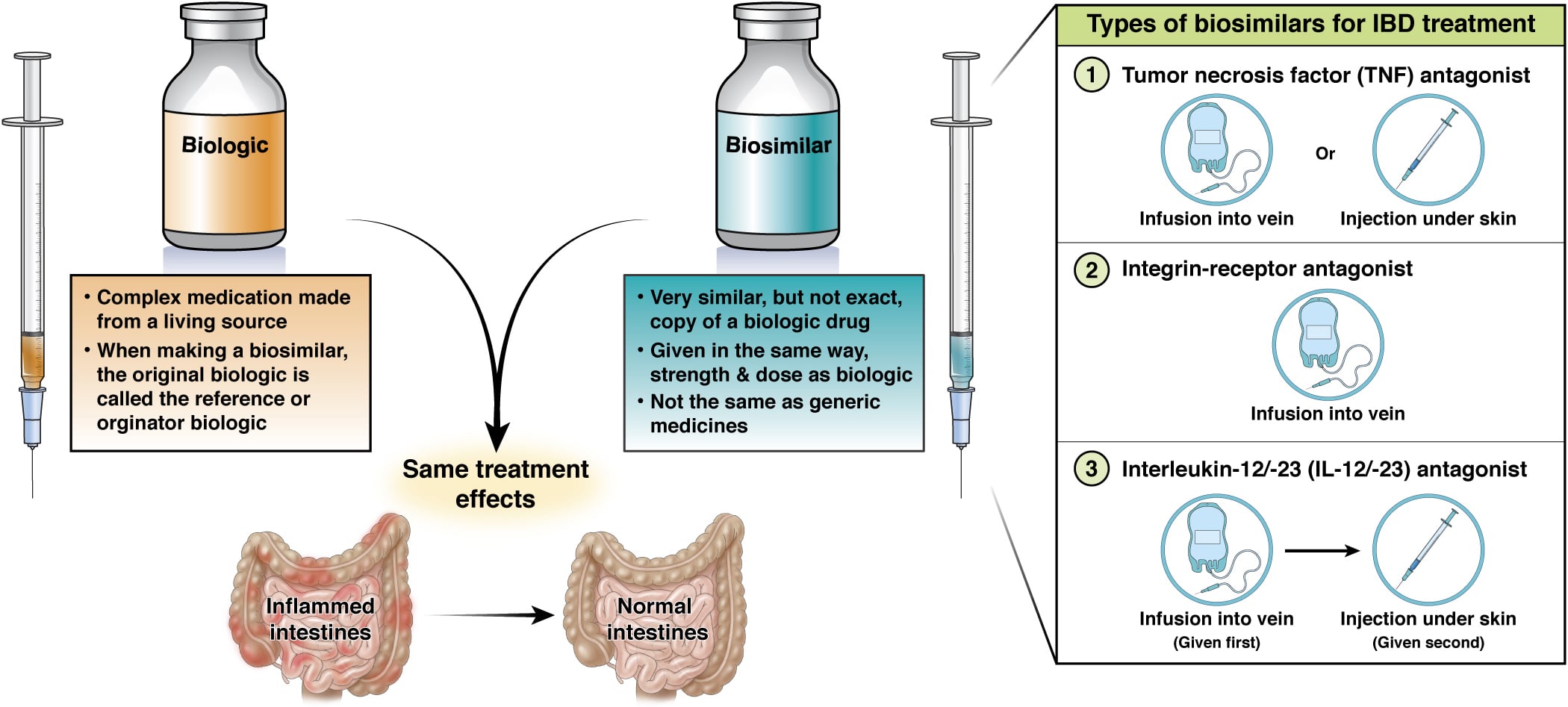
A medicine developed and proven to be highly similar to an existing biologic. Biosimilars are expected to have no differences from the original, or reference, biologic in how well they work and how safe they are. |
|
Biologic |
A type of medicine made using complex processes in living organisms, instead of chemistry. A biologic differs from other drugs in how it is made. |
|
Clinical research trials |
A way for researchers to find out if treatments are safe and if they work. |
|
Efficacy |
How well a medicine works. |
|
FDA |
U.S. Food and Drug Administration. This is the government body that decides if medicines should be made available to patients based on how safe they are, how well they work, and what the side effects are. |
|
Flare |
A term used when a disease has gotten better but then suddenly gets worse. |
|
Generics |
A less expensive option for drugs that are made by chemistry. Generics are an exact replica of the medicine they copy. Because of how biologics are made (complex manufacturing using living organisms instead of chemistry), exact copies (generics) aren’t possible. |
|
Inflammatory bowel disease |
Inflammatory bowel disease (IBD) is a disease where there is inflammation, or swelling, in the gastrointestinal (GI) tract and a life-long immune response. IBD causes the body and immune system to think that food, bacteria, and other needed things in the intestines are not supposed to be there. The body attacks the cells of the intestines, causing inflammation that does not easily go away. The two main types of IBD are ulcerative colitis and Crohn’s disease. |
|
Integrin-receptor antagonists |
A type of biologic used to treat inflammatory bowel disease (IBD) by blocking a protein on the surface of cells and preventing it from moving out of the blood vessels and into tissues. |
|
Interleukin-12/-23 (IL-12/-23) antagonists |
A type of biologic medicine that blocks two cytokines (chemicals made by cells that affect other cells, specifically IL-12 and IL-23) from causing swelling in Crohn’s disease and other autoimmune diseases. |
|
Interchangeability |
Some biosimilars may be called “interchangeable” after extra testing in clinical trials. Interchangeable biosimilars are not yet available for any biologics. All approved biosimilars, whether they are designated interchangeable, meet the FDA’s high standards. |
|
Intravenous infusion |
A way many biologic drugs (including biosimilars) are given. A needle is placed in the patient’s vein, and the medicine is delivered into the vein over a period of time. This is often done in a special medical office called an infusion center. |
|
Immunogenicity |
Refers to a person’s immune system “rejecting” a medicine. |
|
Nocebo |
A term used when unwanted effects of a medicine are thought to be caused by a person’s thoughts about the medicine and not the medicine itself. For example, if a person thinks they will experience a specific side effect of a treatment, they might experience the symptoms because of those thoughts. |
|
Originator biologic |
The original (first) biologic of its type approved by the FDA. Biosimilars copy the original biologic after its patent expires. Also called originator product, reference biologic, or biologic product. |
|
Payor |
The organization paying for a medicine. For example, insurance companies and Medicare are payors. |
|
Pharmacokinetics |
What happens to a medicine once it’s put into the body in terms of the amount available and the amount of time it remains available. Pharmacokinetic studies are done with biosimilars to make sure the original biologic and biosimilar are treated the same by the body. |
|
Reference biologic |
The reference (first) biologic of its type approved by the FDA. Biosimilars copy the original biologic after its patent expires. Also called originator biologic, reference product, or biologic product. |
|
Side effects |
Undesirable things that may happen with a medicine. Studies of biosimilars look at side effects to make sure there are no meaningful differences between the original biologic and the biosimilar. |
|
Tumor necrosis factor (TNF) antagonists |
A type of biologic that binds to and blocks a small protein called TNF-α, which is linked to swelling in the intestine and other organs and tissues. TNF antagonists (also known as TNF inhibitors) lessen the symptoms of IBD and help heal an inflamed intestine. Biosimilars are available for this kind of biologic. |
REVIEWED BY

Joseph D. Feuerstein, MD, AGAF
Clinical chief, gastroenterology
Beth Israel Deaconess Medical Center

Sarah Streett, MD, AGAF
Clinical professor, medicine - gastroenterology & hepatology
Stanford Medicine
Updated Nov. 13, 2025